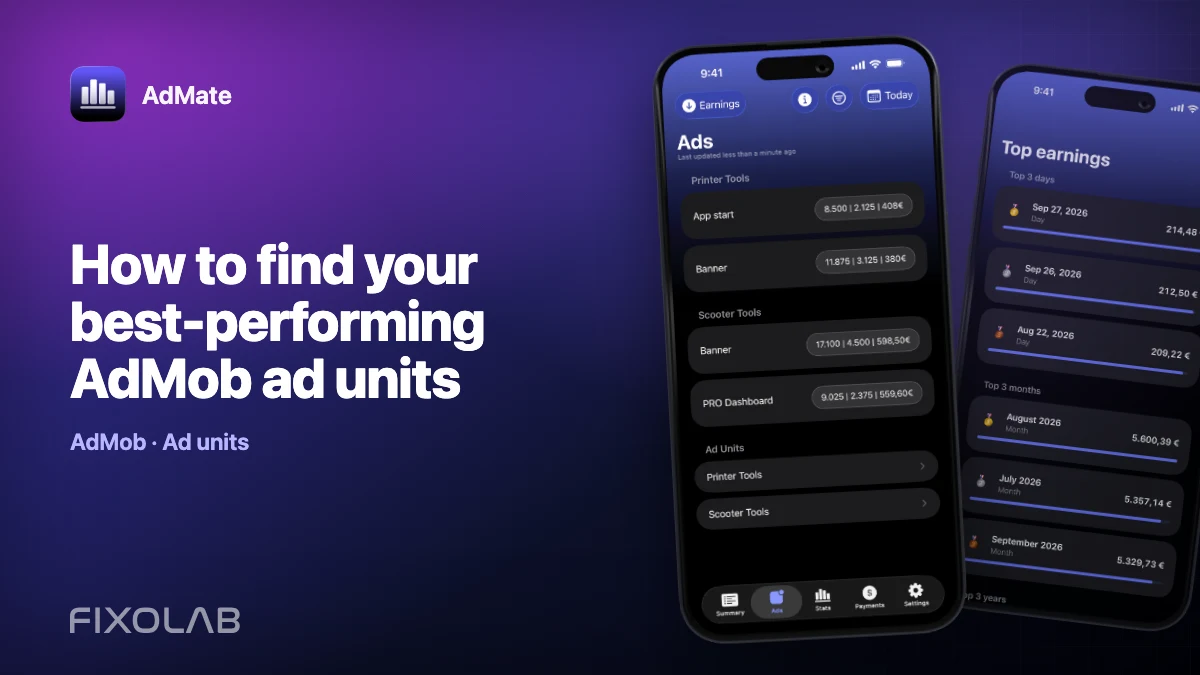
How to find your best-performing AdMob ad units
The ad unit with the highest eCPM is not automatically the best-performing unit. It may have very few impressions, belong to a high-value country or represent a format shown only at a specific moment. A useful review balances total contribution, rate, scale and user experience.
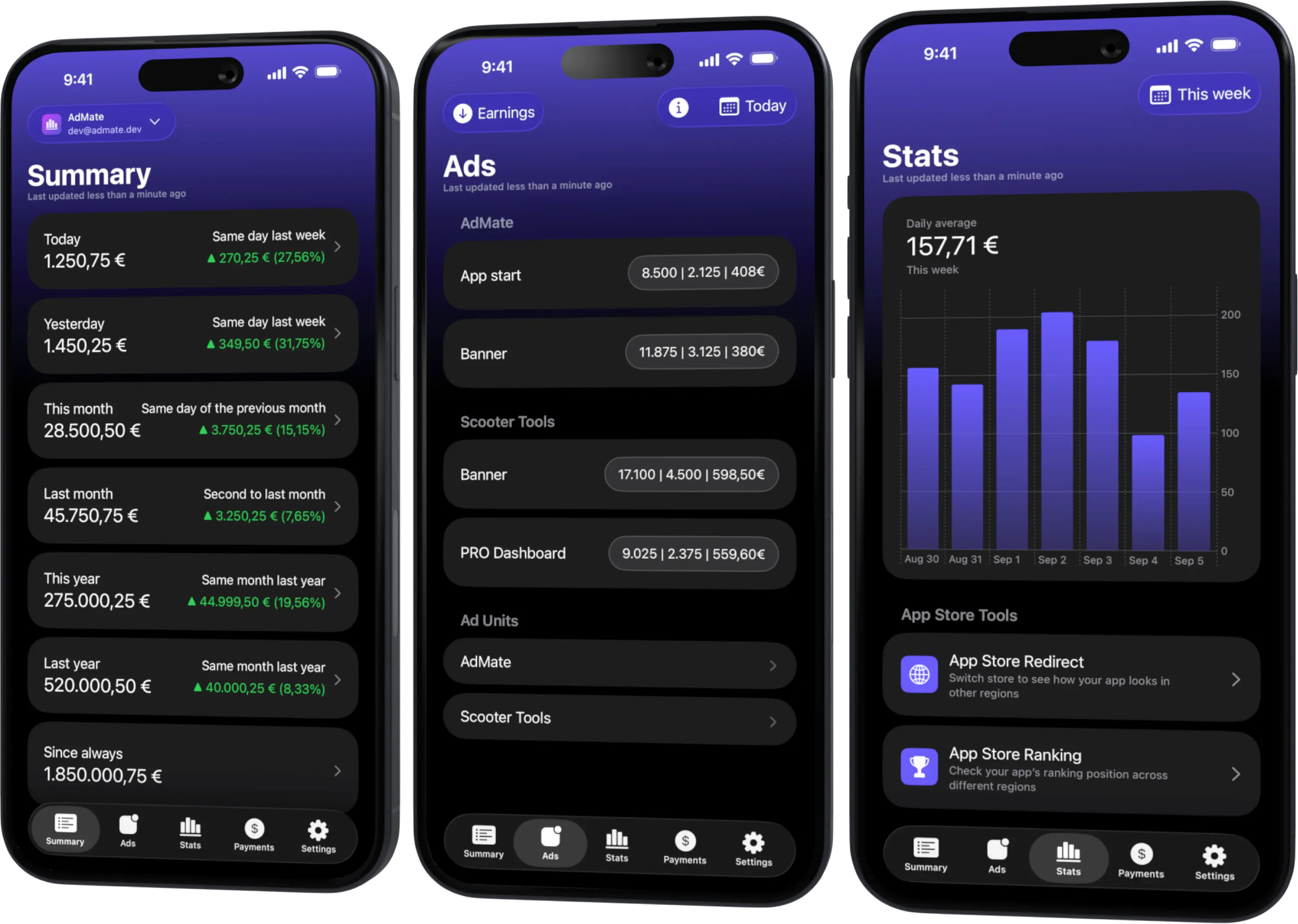
AdMate can help you move from a publisher total into app and ad-unit breakdowns while preserving AdMob’s metrics.
All your revenue in one dashboard
Track AdMob, AdSense, RevenueCat and App Store Connect across multiple accounts with filters by app, platform and country
Monitor revenue, clicks, eCPM, subscriptions, installs and payments on iPhone, iPad, Mac and Apple Watch
Define “best” first
Possible goals include:
- highest total estimated earnings;
- strongest eCPM at meaningful volume;
- most stable contribution over time;
- best result for a particular app, country or format;
- acceptable monetization with an appropriate user experience.
No single column answers every goal.
Use a meaningful period
Choose a complete range long enough to reduce daily noise. Seven or 28 completed days are often more informative than the current day, but product launches and seasonal events may need separate treatment.
Compare the same duration and weekday mix. Note releases, campaigns or consent changes that altered traffic.
Read four metrics together
Estimated earnings
Shows contribution to the selected scope. A high-volume unit can lead here even with moderate eCPM.
Impressions
Provides the denominator and scale. An impressive rate on a tiny sample needs more observation.
eCPM
Helps compare value per thousand impressions. Read it with country and format mix.
Requests and match-related metrics
Help distinguish low opportunity from low demand or a problem before impression.
Clicks can be useful for provider reporting, but never optimize placement to create accidental or incentivized clicks.
Build an ad-unit table
For each app, record:
| Ad unit | Format | Earnings | Impressions | eCPM | Notes |
|---|---|---|---|---|---|
| Unit A | Banner | Provider value | Provider value | Provider value | Stable placement |
| Unit B | Rewarded | Provider value | Provider value | Provider value | User-initiated flow |
Use the table structure, not invented values. Sort by earnings, then inspect eCPM and volume.
Compare like with like
Do not rank a rewarded unit against a banner without considering how each format is used. Separate:
- format;
- app and screen;
- country mix;
- consent population;
- platform;
- time period.
The correct question may be “Which banner unit is healthiest?” rather than “Which unit has the highest number?”
Spot useful patterns
- High earnings, high volume, stable eCPM: important contributor worth monitoring.
- High eCPM, low volume: promising but not yet conclusive.
- High requests, low impressions: inspect match and display path.
- Falling eCPM with stable volume: inspect geography, demand and format mix.
- Sudden click spike: verify policy compliance and accidental interaction risk.
Do not change production placement from one unexplained spike.
Protect user experience and policy compliance
Revenue optimization must stay within AdMob policies and platform guidelines. Keep controls distinguishable from ads, do not encourage clicks, respect consent and avoid intrusive frequency. AdMate reports results; it does not validate a placement’s policy compliance.
A repeatable workflow
- Refresh the AdMob account.
- Select a complete period.
- Choose one app.
- Open its ad-unit breakdown.
- Sort by estimated earnings.
- inspect impressions and eCPM for the leading units;
- compare with the previous equal period;
- annotate product or placement changes;
- verify material anomalies in AdMob.
Read eCPM, impressions, fill and revenue explained for the metric chain.
Frequently asked questions
Is the highest eCPM unit the winner?
Not without meaningful volume, a fair comparison and acceptable user experience.
Should I remove a unit with low eCPM?
Investigate its volume, format, geography and role first. A single metric is insufficient.
Can AdMate change ad-unit settings?
AdMate is a reporting and management dashboard for supported data; make serving and placement changes through the proper app and provider workflows.
How often should I compare units?
Use a regular complete period and investigate sudden material changes rather than reacting to every hourly movement.
All your revenue in one dashboard
Track AdMob, AdSense, RevenueCat and App Store Connect across multiple accounts with filters by app, platform and country
Monitor revenue, clicks, eCPM, subscriptions, installs and payments on iPhone, iPad, Mac and Apple Watch
| FixoLab
How to monitor multiple AdMob accounts in one dashboard
Organize several AdMob publisher accounts in AdMate, keep client scopes separate, compare like-for-like periods and avoid duplicate totals.
| FixoLab
Track AdMob, RevenueCat and App Store Connect in one dashboard
Use AdMate to review AdMob, AdSense, RevenueCat and App Store Connect across multiple accounts without sending revenue through an AdMate server.
| FixoLab
How to compare app revenue across date ranges
Build fair daily, weekly and monthly revenue comparisons in AdMate by aligning duration, account scope, app filters, time zones and incomplete periods.
| FixoLab
How to compare iOS and Android monetization in one dashboard
Compare iOS and Android advertising, subscription and store performance in AdMate without mixing incompatible metrics, currencies or overlapping transactions.